Child marriages linked to higher fertility rates
Child marriages lead to higher teenage age specific fertility rates
Even though the extent of child marriages has reduced over the years, UNICEF estimates that approximately 650 million women today were married before they turned eighteen.[1]
In Kenya, 4.1% of females and 3.9% of males aged 12 – 15 were married in 2019. Extending the age group to include 12 – 18-year-old girls reveals that 6.1% were married at the time of the census.
Child marriages are associated with higher fertility rates
The total fertility rate is the average number of children a woman will likely get by the end of her childbearing years.[2] It is arrived at by summing the age-specific fertility rates of all age groups in a population and multiplying the result by the width of the age groups.[3]
Early marriages tend to lower the median age at first sexual intercourse as well as the median age at first birth. As a result, child marriages increase the rate of teenage pregnancies and the total fertility rate of a population.[4]
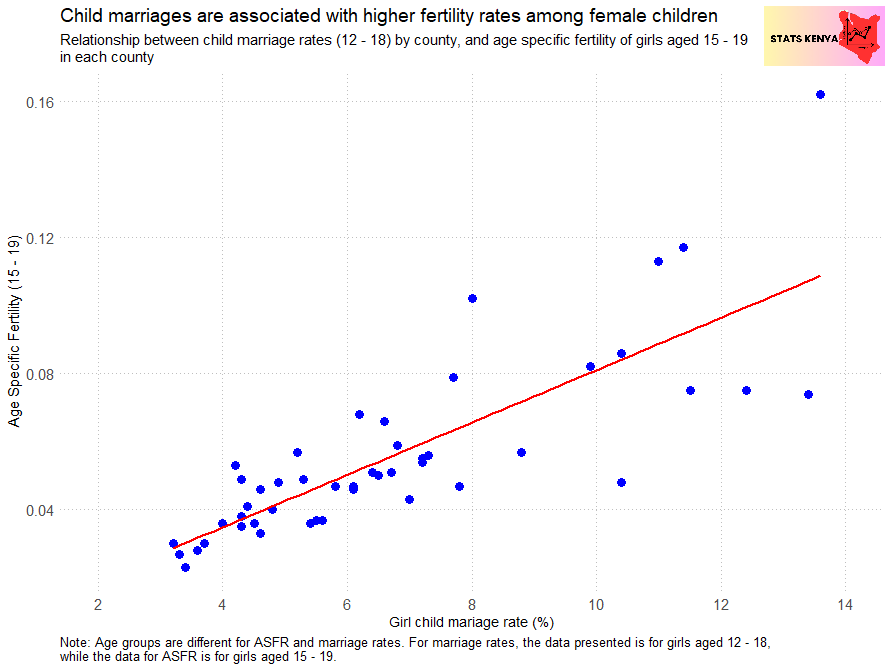
The chart below depicts the relationship between the girl child marriage rate of females aged 12 -18 in each county in Kenya and the age-specific fertility rate of girls aged 15 – 19. The correlation is positive and significant (r = 0.806, p<0.000000), suggesting that an increase in child marriage rates was associated with a strong positive increase in the fertility rates of the females in that age group.

Each dot on the chart represents a Kenyan county. In 2019, Mandera County had the highest child marriage rate of 13.6% and, consequently, the highest age-specific fertility rate of 0.16 births per 1,000 women.
In contrast, Nairobi and Kiambu had child marriage rates of 3.2% and 3.3%, respectively, and each had an age-specific fertility rate of 0.03 births per 1,000 women.[5]
A limitation of the data is that age groups do not overlap. While we have the marriage rates of girls aged 12 – 18, the age-specific fertility rates used in this analysis are for girls aged 15 – 19. However, this limitation is unlikely to significantly affect the overall direction and strength of the relationship.
See Also
- Child marriages in Kenya by county
- Crude birth rates in Kenya by county
- Marriage rates in Kenya by county
- Child marriages and teenage pregnancies in Kenya
References
[1] UNICEF (2022). Child marriages. Accessed https://data.unicef.org/topic/gender/child-marriage/
[2] Max Roser (2014) - “Fertility Rate” Published online at OurWorldInData.org. Retrieved from: 'https://ourworldindata.org/fertility-rate' [Online Resource]
[3] USAID. Age-specific fertility rates. Accessed https://www.data4impactproject.org/prh/family-planning/fertility/age-specific-fertility-rates/
[4] Onagoruwa, A., & Wodon, Q. (2018). Measuring the impact of child marriage on total fertility: A study for fifteen countries. Journal of Biosocial Science, 50(5), 626-639.
[5] KNBS (2022). 2019 Kenya Population and Housing Census: Analytical report on fertility and nuptiality. Vol. VI